.png)
.png)
Platform
Who's it for?
Compare


Agencies today face an avalanche of ecommerce data across ad channels, marketplaces, and analytics dashboards. Manual tracking and reporting have become impractical for competitive markets where decisions need to happen in real time. Automating ecommerce research isn't just a productivity gain; it's essential for accuracy, agility, and consistent client results at any portfolio size.
Modern ecommerce agencies use advanced AI tools and analytics automation to unify customer journeys, attribute revenue correctly, and surface insights faster.
Below are seven proven ecommerce analytics tools reshaping how agencies conduct research, from attribution dashboards to qualitative UX intelligence.
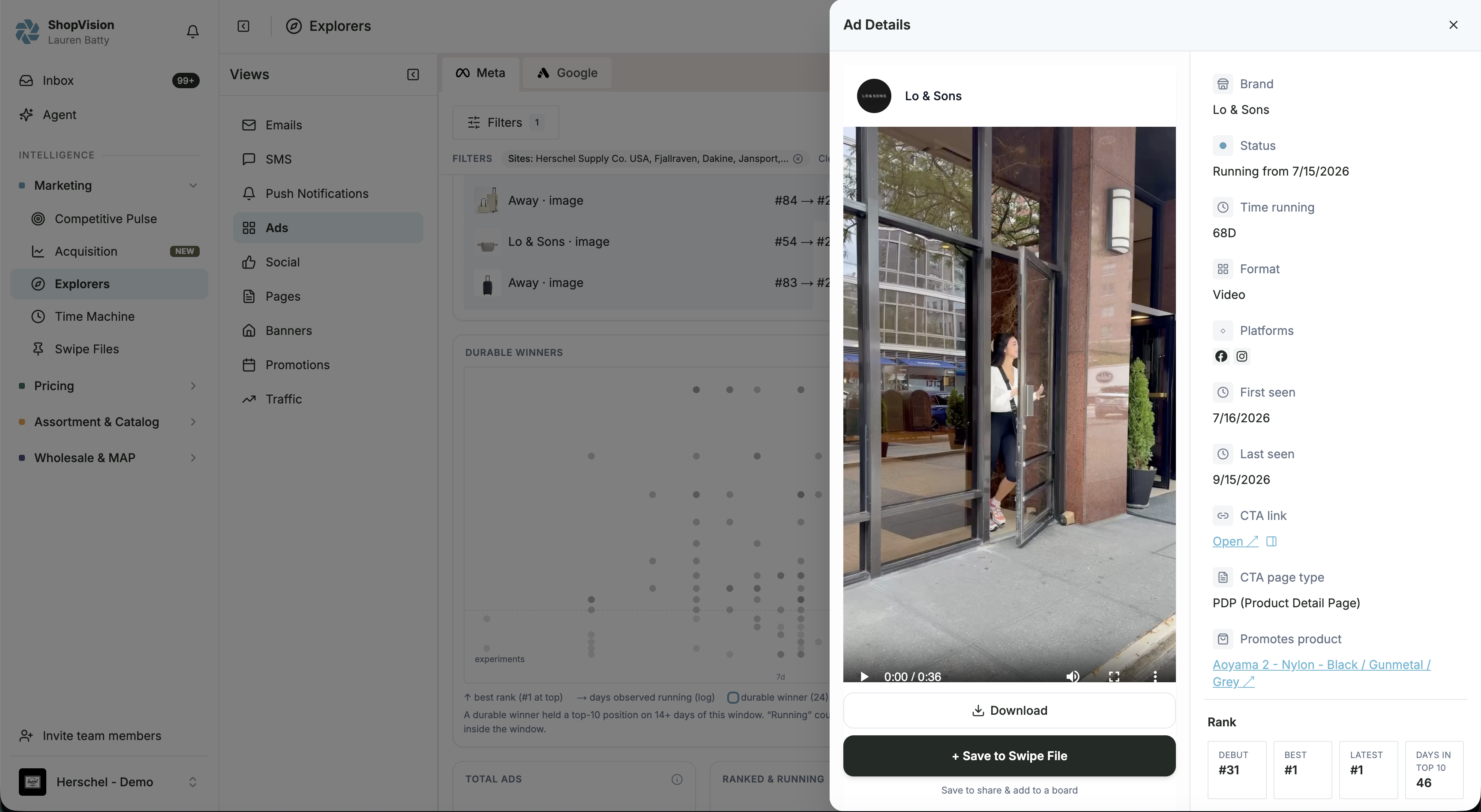
ShopVision is an AI-powered central hub for competitive and market intelligence, designed specifically for ecommerce agencies. The platform brings together live market signals, internal performance data, and external competitive insights into a single actionable view.
Its automation layer generates summary reports, real-time alerts, and integrations across analytics, pricing, and advertising systems, removing the manual data stitching step entirely. Agencies often reduce their weekly data processing time to under 15 minutes, aligning campaign and pricing strategies more quickly with market shifts.
For agency operations, ShopVision offers a dedicated multi-account structure: one account per brand with all international domains bundled together. A single contract can cover an entire client portfolio, with growing discounts as the agency expands its book of business. Enterprise-tier access provides unlimited monitored sites and flexible user seats, making ShopVision's AI-driven competitive intelligence a dependable backbone for multi-brand research automation.
Triple Whale is a Shopify-native analytics and attribution dashboard built for agencies managing performance-focused online stores. Its automation framework connects key ecommerce metrics with marketing channels, giving teams a clear picture of profitability and attribution without manual spreadsheet work.
Key capabilities include:
Triple Whale's pricing is performance-scaled, starting near $179 per month for smaller merchants and reaching around $549 monthly for brands generating $1M to $2.5M in GMV. It suits agencies needing precise attribution across multiple clients.
Polar Analytics provides a plug-and-play analytics environment for agencies representing direct-to-consumer brands operating across multiple storefronts. It integrates Shopify, Amazon, TikTok Ads, Meta, and Google with minimal configuration, automatically generating pre-built ecommerce dashboards.
The advantage is speed: agencies can onboard a new client's reporting within hours. Polar Analytics is strong at cross-store aggregation and consistent roll-up reporting, making it effective for teams managing numerous DTC clients. Customization is more limited than full-scale BI tools, but the platform delivers a practical balance of cost and efficiency for fast-moving agencies.
Mixpanel gives agencies deep visibility into user behavior and product engagement through an event-based analytics framework. Each user action (view, click, add-to-cart, or purchase) is logged as an event, enabling analysis of conversion funnels, retention cohorts, and session trends.
This event-first approach supports automation in behavioral reporting, so agencies can quickly gauge how UX changes or campaign variations affect conversion paths. Mixpanel's free tier includes up to 1 million events per month, with scale-based pricing beyond that.
Complex setups take some learning, but the payoff is in Mixpanel's segmentation and real-time funnel analysis, which is essential for optimizing user experiences across ecommerce client portfolios.
Matomo offers full analytics automation with a privacy-first focus, which is a good fit for agencies whose clients prioritize compliance and data control. Unlike cloud-native tools reliant on third-party data, Matomo can be self-hosted, ensuring complete data ownership.
Features include:
Matomo's on-premise version is free, while its hosted cloud starts near $23 per month. Technical setup is more involved, but the ability to automate analytics under strict governance makes Matomo a trusted choice for privacy-sensitive ecommerce clients.
Supermetrics simplifies one of the most time-consuming parts of agency work: data extraction and reporting. Using ETL (Extract, Transform, Load) automation, it aggregates data from marketing, ecommerce, and ad platforms, harmonizes it, and delivers it to Google Sheets, Looker Studio, or data warehouses.
For agencies, this reduces repetitive reporting tasks and creates consistent, automated dashboards. Supermetrics supports many channels, from Shopify and Amazon to Meta Ads and Google Analytics, helping teams consolidate cross-platform metrics without manual exports. Pricing scales by connector and data volume, aligning with an agency's growth stage.
Hotjar (and similar platforms like Mouseflow) automates the qualitative side of ecommerce research, the "why" behind user actions. Agencies can analyze heatmaps, watch session replays, and deploy micro-surveys to pinpoint friction in the shopping journey.
Automated collection of these insights helps prioritize UX improvements and conversion optimizations. Hotjar's free plan supports around 20,000 recorded sessions per month, while Mouseflow extends capabilities with form analytics and journey mapping. These tools remain valuable for agencies focused on UX research automation, even if they serve different use cases than analytics or attribution platforms.
For marketplace-driven ecommerce clients, Jungle Scout automates product research and competitive benchmarking. It compiles live sales estimates, review volumes, ratings, pricing trends, and keyword data directly from Amazon.
Its Chrome extension displays SKU-level metrics such as monthly revenue and sales estimates instantly. For Walmart sellers, alternative marketplace intelligence tools offer similar capabilities, surfacing average prices and listing insights for faster optimization decisions.
Agencies use these platforms to accelerate product validation, track competitors, and identify high-performing niches, turning manual research hours into minutes.
Each of these tools tackles a specific layer of ecommerce intelligence. The most effective agency stacks combine them modularly to cover every research layer without manual handoffs.
A balanced configuration might look like this:
When selecting tools, agencies should weigh integration breadth, data ownership needs, client platform type (Shopify vs. marketplace), and pricing models that fit projected client volumes.
Automation saves agencies time, reduces errors, and delivers real-time insights, so teams can focus on higher-value strategy.
Automation tools unify and standardize data flows, creating more reliable multi-source reporting.
Integration range, privacy requirements, platform alignment, and cost scalability are the key considerations.
Self-hosted or hybrid platforms help maintain privacy compliance alongside automation efficiency.
Well-configured automation stacks can cut ecommerce research time to under 15 minutes weekly, improving productivity.
Stop stitching ecommerce research together by hand. Request a demo to see how ShopVision gives agencies one platform for competitive and market intelligence across every client.