Who's it for?
Compare


Most BFCM recaps measure a brand against its own last year. Revenue versus plan, conversion versus 2025, AOV, email revenue, and the CAC line everyone hoped would behave. That tells you how you did. It can't tell you why, because most of the why sits in what your competitors did during the same five days.
If a competitor opened early access on November 13 and you opened on the 20th, your soft first week has a cause. If a reseller broke MAP on Thanksgiving night and four others matched by morning, your lost buy box has a cause. Neither shows up in your analytics stack.
Below is the competitive recap we run with brands every December. Run it now and it explains your results in the BFCM recap meeting, and shows how each competitor is likely to behave through Boxing Day. Carry it into January, when most teams set the year's promo calendar and price floors, and it becomes the baseline for that plan. Ten questions, in the order we work through them, with what to pull for each and what the answer tends to change.
What to pull in ShopVision: The date each competitor launched early access, Black Friday, and Cyber Monday offers, on one Marketing Calendar, with your own dates laid on top.
What it tells you: Most categories have a first mover that resets shopper expectations for everyone else. If you launched after it, your first week was spent answering someone else's offer. If you launched well ahead of the pack, check whether those early days converted or taught your customers to wait for a deeper second wave.
Prompt to run in ShopVision: "Build a marketing calendar of every BFCM offer my competitors ran between November 1 and December 1, 2026. For each competitor, show the start and end dates of their early access, Black Friday, and Cyber Monday offers, with our own offer dates added for comparison. Who launched first?"
What to pull in ShopVision: Offer depth, mechanics (sitewide, tiered, codes, gift with purchase), and duration for every competitor.
What it tells you: The headline percentage is the least useful number on the page. A flat 25% sitewide and an "up to 40%" tiered offer read differently to a shopper and cost differently to the brand running them. Duration carries as much weight as depth: 20% for eleven days can outsell 30% for 48 hours. Compare like mechanics against each other before you compare depth.
Prompt to run in ShopVision: "Compare every competitor's BFCM 2026 offers: discount depth, mechanic (sitewide, tiered, code-based, gift with purchase), and how many days each offer ran. Group them by mechanic and flag any offer that went deeper or ran longer than ours."
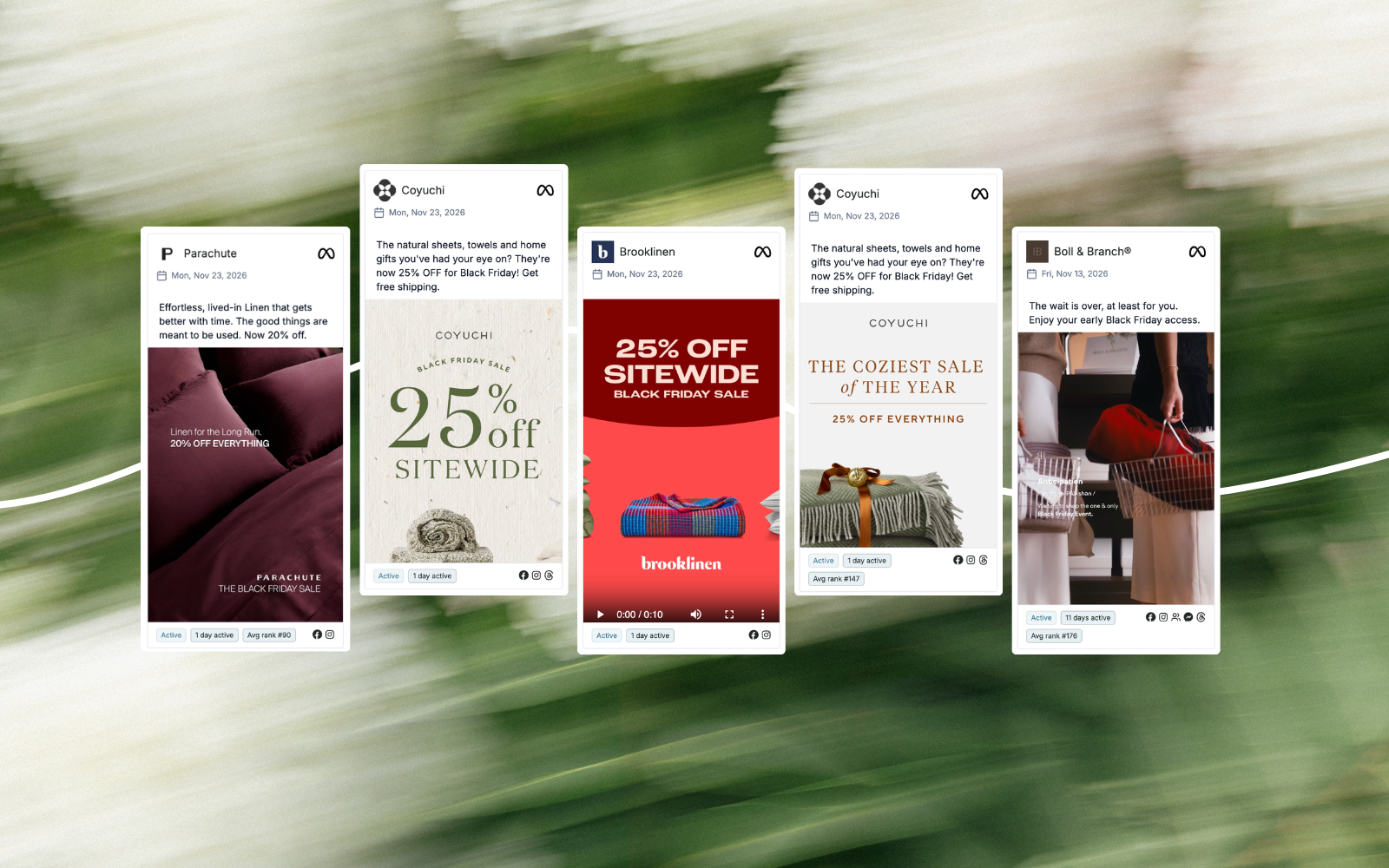
What to pull in ShopVision: Email and SMS cadence, ad volume and creative by channel, and site changes across the season in Time Machine (homepage takeovers, nav changes, banners, gift guides).
What it tells you: Where the category's attention went, and what message won it. If a competitor doubled SMS volume the week before Black Friday while you held flat, their customers, and some of yours, heard from them more often. The creative shows you the angle that carried the season, whether that was urgency, gifting, bundles, or price.
Prompt to run in ShopVision: "Summarize each competitor's email and SMS send volume by week from November 1 to December 1, 2026, along with their ad volume by channel. What were the main creative themes and offers in their messaging, and how did their homepage change across the season?"
What to pull in ShopVision: A variant-level price ladder for your products and their matched competitor equivalents through the season, plus price forensics to show who moved first on each change.
What it tells you: The specific products, and the specific days, where you were undercut. Variant level matters here. A competitor can hold price on its core colorway and cut the slow ones; viewed at product level, it looks like they held the line.
Prompt to run in ShopVision: "Show the variant-level price history for our top 50 products and their matched competitor products from November 1 to December 1, 2026. List every day a competitor was priced below us, by how much, and which competitor moved first on each price change."
What to pull in ShopVision: Products where your discount ran deeper, or longer, than the matched market needed.
What it tells you: This is question 4 in reverse, and it's the one most recaps miss because it shows up as a win. If you were 35% off on a product where every matched competitor sat at 20%, you moved units and paid for margin the market didn't ask for. This list sets your price floors for the December push and Boxing Day, before the same products get discounted twice. In January, it's the case for making those floors permanent.
Prompt to run in ShopVision: "Find the products where our BFCM 2026 discount was deeper, or ran longer, than every matched competitor product. Show our discount, the deepest competitor discount, and the gap in percentage points, sorted by largest gap."
What to pull in ShopVision: New products launched in-season, holiday assortment depth (gift sets, bundles, limited colorways), discontinuations, and top sellers.
What it tells you: Whether competitors used BFCM to launch as well as discount, and what they were clearing. A discontinued line usually shows up as a deep discount. Matching it means matching someone else's inventory exit, which is a poor reason to cut your own price.
Prompt to run in ShopVision: "List every new product my competitors launched between November 1 and December 1, 2026, their holiday assortment (gift sets, bundles, limited editions), any products they discontinued, and their top sellers over the period."
What to pull in ShopVision: Competitor out-of-stock windows by product and date.
What it tells you: Demand that had nowhere to go. If a rival's best seller was out from Saturday through Cyber Monday, those shoppers bought a substitute or waited. The question is whether the substitute was yours, and whether you had spend behind it while they were dark. Stock that ran thin at BFCM rarely recovers before the holidays, so between now and Boxing Day, watch competitor stock on hero products and move budget when it runs out.
Prompt to run in ShopVision: "Show every competitor out-of-stock event on products that match ours between November 1 and December 1, 2026, with the product, the date it went out of stock, the date it came back, and whether it is in stock today."
What to pull in ShopVision: Every violation, with screenshot, timestamp, URL, and duration.
What it tells you: Which partners held during the highest-pressure week of the year, and which didn't. A dated, screenshotted record changes the enforcement conversation. You're discussing a specific listing at a specific time, and nobody argues with a timestamp. Have those conversations now, while the evidence is a week old and before Boxing Day pricing starts.
Prompt to run in ShopVision: "List every MAP violation across our resellers between November 1 and December 1, 2026, with the reseller, product, advertised price, MAP price, timestamp, URL, screenshot, and how long each violation lasted. Rank resellers by number of violations."
What to pull in ShopVision: The instigator behind each buy box loss or price-match cascade, plus any Amazon suppression on your listings.
What it tells you: Cascades usually start in one place. One reseller drops, repricers follow within hours, and Amazon can suppress your buy box when your price looks high against the rest of the market. Finding the instigator means one enforcement conversation instead of a dozen. To size the cost, multiply suppressed hours by typical hourly sales on the affected listings.
Prompt to run in ShopVision: "For each buy box loss or price-match cascade on our products during BFCM 2026, identify the first seller to drop price, when they dropped it, and which sellers followed. Include every period our Amazon listings were suppressed and how long each one lasted."
What to build: Answers 1 through 9, organized by the team that owns each decision.
What it tells you: A recap only matters if it changes what you do next. We hand it back as an action plan by team, in two parts.
Now through Boxing Day
For January planning
January is when most brands lock the year's promo calendar, pricing rules, and spring buy. It's the one planning moment where BFCM evidence is still fresh enough to argue with.
Prompt to run in ShopVision: "Using the BFCM 2026 competitive analysis above, write an action plan by team (marketing, pricing, merchandising and buying, sales and channel), split into what to change before Boxing Day and what to bring into January planning."
The data from inside your own building is already in a dashboard somewhere. The competitive half is the part most teams never see.
We'll pull what your category did across BFCM 2026: every competitor's calendar, offers, channel activity, price moves, stockouts, and MAP record. Then we walk your team through it and leave you with an action plan for the rest of the season, plus the competitive baseline for January planning.
Book your BFCM competitive review