%20(23).png)
.png)
Platform
Who's it for?
Resources
Compare


%20(1)%20(1).png)
Most competitive monitoring for Black Friday 2026 will start in October. The trouble with October is that by then it's all decided. Promo calendars are signed off, discount depth has been through finance, the creative is built and booked. You can watch the whole thing happen and there's very little you can do about any of it.
August is different because there's still time on the clock. It's also a much lower-stakes season, run by the same team on the same systems, less pressure. Which got me wondering whether back to school is really just a dress rehearsal for BFCM. And if that's what it is, then all of us who start looking in October are turning up about six weeks late.
Reason it's worth asking: the money is real, the season just never gets a countdown clock and a war room. The NRF has 2026 back-to-school spending at $146.8 billion, up from $128.2 billion last year, second only to the winter holidays for US consumer spending.[^1] Clothing is $12.5 billion for K-12 plus another $13.1 billion for college, shoes $8.7 billion, supplies $7.3 billion, dorm furnishings $14 billion.[^2] Backpacks, bottles, bedding. And it starts earlier than you'd think, with 62% of shoppers already going by early July.[^3]
So rather than sit here theorising, we went and looked at what the tween and teen brands are actually doing right now. Five of them, all tracked daily on pages you can go and open yourself.[^4] Same three weeks, same season, and five completely different answers.
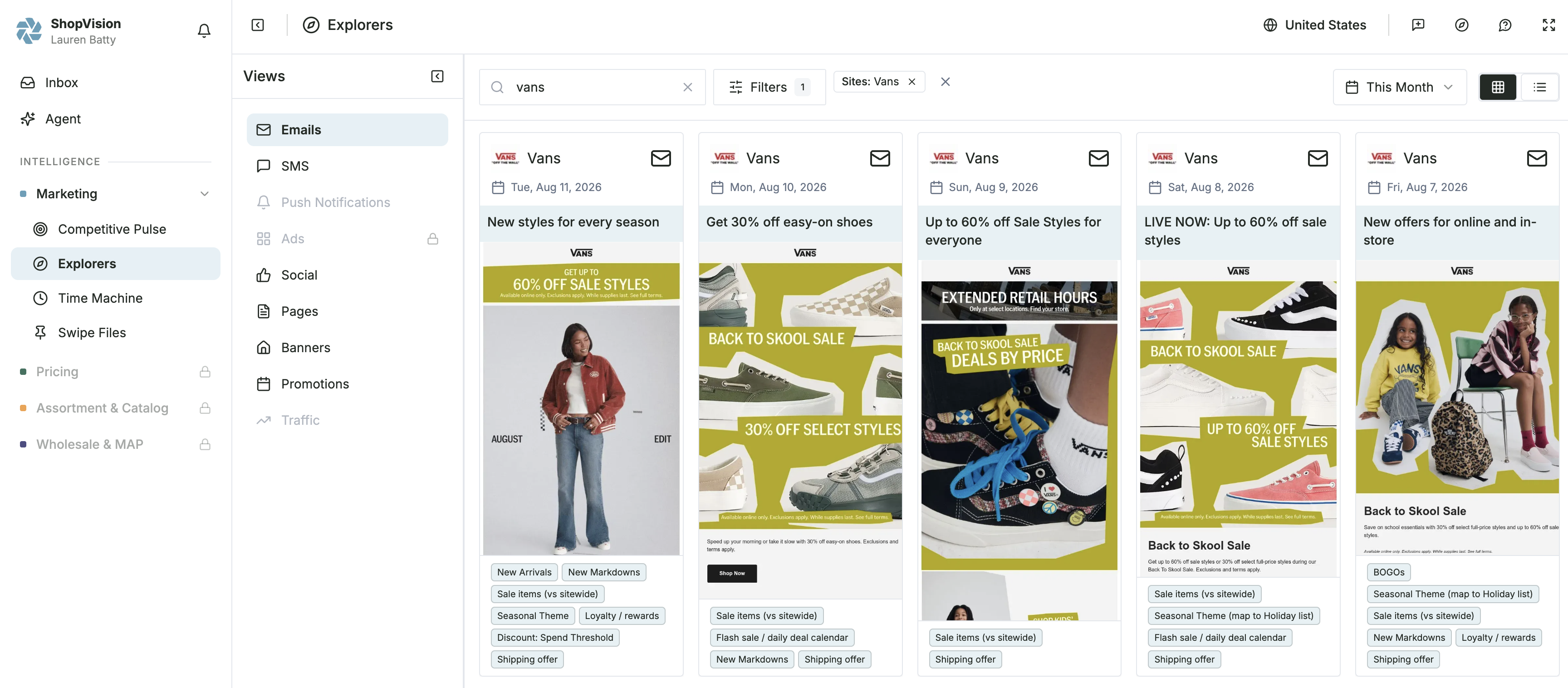
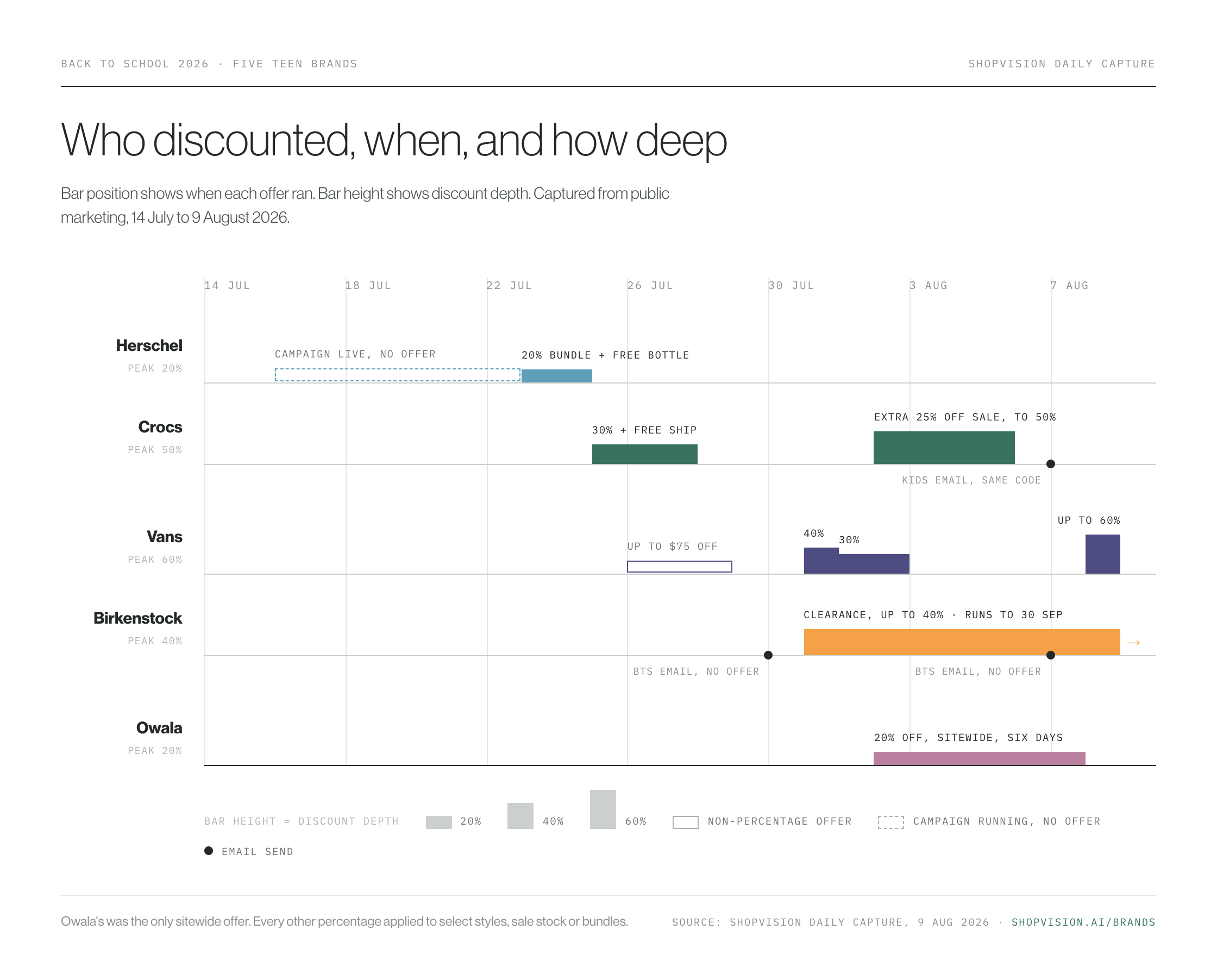
Vans got going on July 26 with a buy-more-save-more, up to $75 off, and closed it with a "final hours" email on the 29th. The Back To Skool Sale proper landed on the 30th. Then 40% off select styles on the 31st, 30% off tees, denim and chinos on August 1 and 2, all of it on select styles rather than sitewide, and by August 8 it was "LIVE NOW: Up to 60% off sale styles," which went out again on the 9th.
The numbers don't climb in a straight line, and I think that's the interesting bit. 40%, then 30%, then 60%. The headline depth moves around depending on what's sitting in the sale that week, which is what a big markdown pool looks like from the outside.
Either way, 60% is the loudest number anyone in this set put in front of a shopper, and they were saying it in subject lines by the second week of August. Worth noting that all of those are the offers as Vans advertised them, and "up to 60%" is a ceiling rather than a rate. How much of the range actually sat at 60% isn't something you can tell from the outside.[^5]
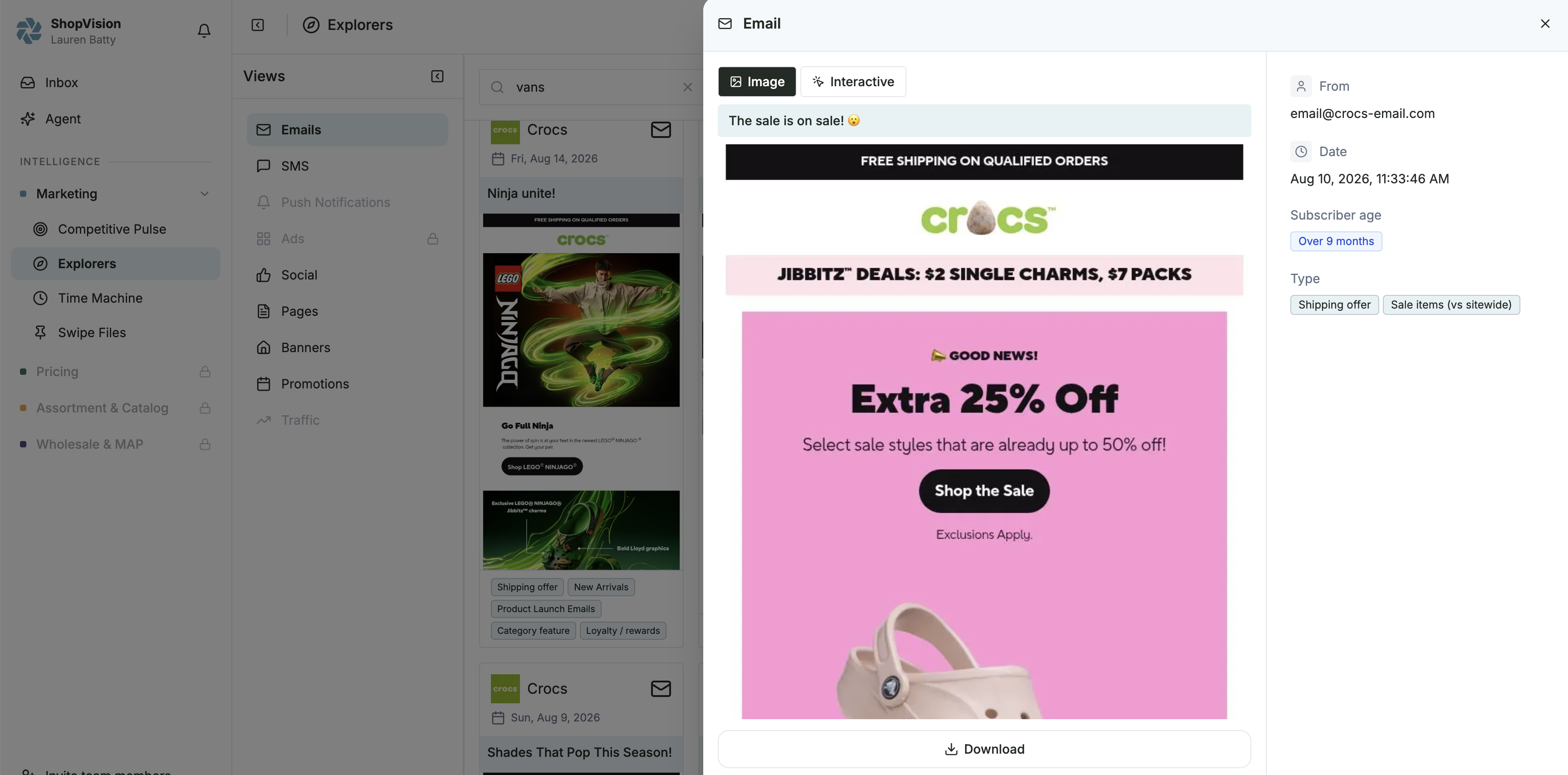
30% off plus free shipping across three emails on July 25, 27 and 28, first call through final hours. Then from August 2 there's an extra 25% off on top, and our records log that one as "Extra 25% Off Select Sale Styles (Up to 50% Off)." Select sale styles, not the whole shop.
Now, the August 7 back-to-school email for kids carries the same AUGextra25 code in its tracking as the sale emails do. Which means back to school never got its own offer here. It's a creative wrapper on the promo that was already running.
They also pushed an Afterpay creative on August 5. I think that's the smartest thing in this whole set, because it goes at affordability through payment terms instead of price, and you'd miss it completely if you were only tracking discount depth.[^6]
Two back-to-school emails, July 30 and August 7, and neither subject line mentions a discount. "Back to school? Back in BIRKENSTOCK" and "Get ready, your Back-to-School styles are here." Both selling newness.
They are discounting, but it belongs to something else. A summer Last Chance clearance at up to 40% off, with an extra 10% for everyone and 15% for VIPs, US only, running through September 30. Old stock on its own track, while the seasonal creative sells current product at full price.
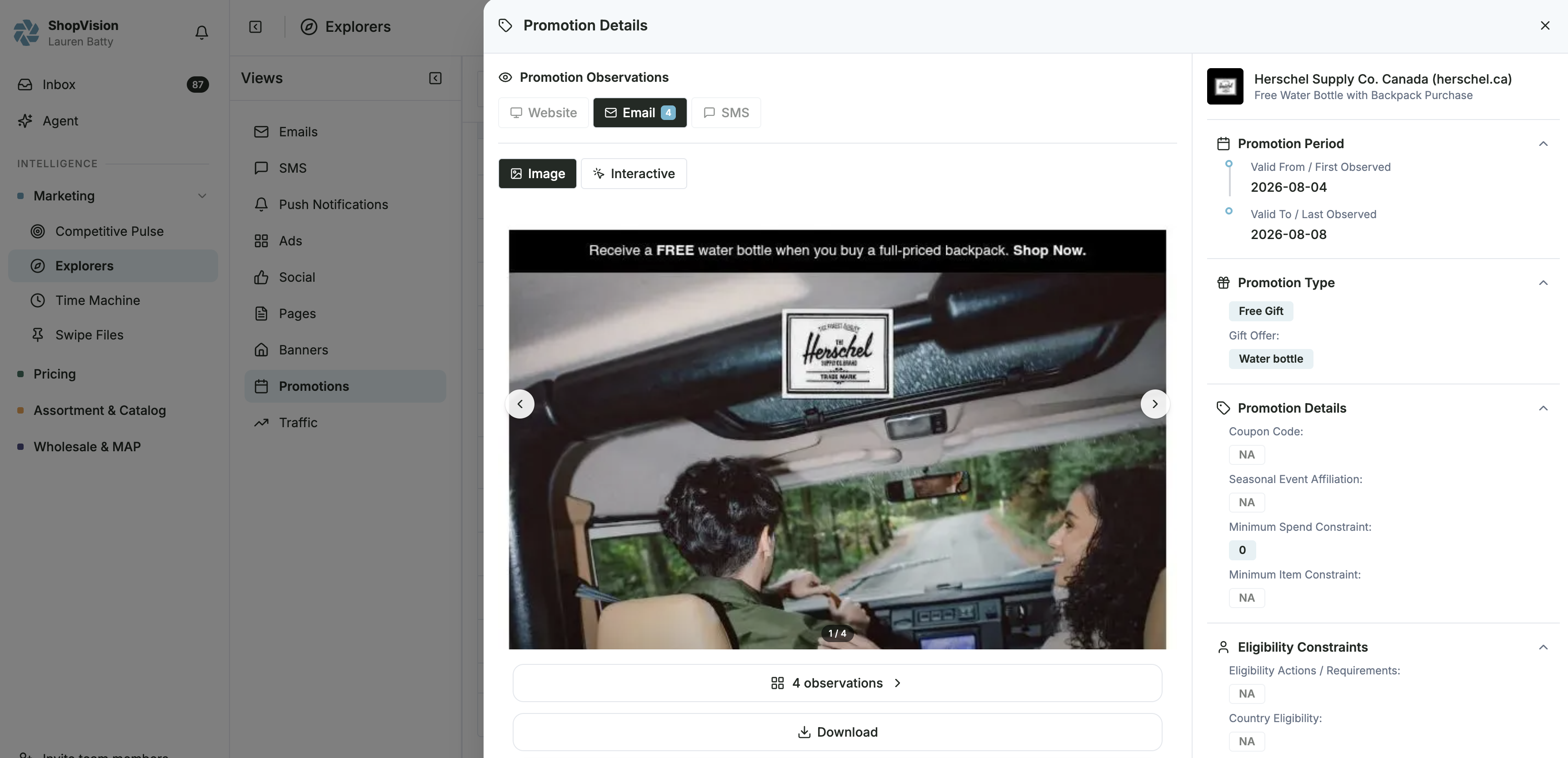
The rest of what they're doing points the same way. Their lead social channel is Pinterest, which nobody else in this set uses, and the copy is aimed squarely at the customer rather than the price. "New grade. New shoes. No notes."
So if you compete with Birkenstock, their discount tells you nothing about their season. What you'd want to watch is whether the full-price product moves.
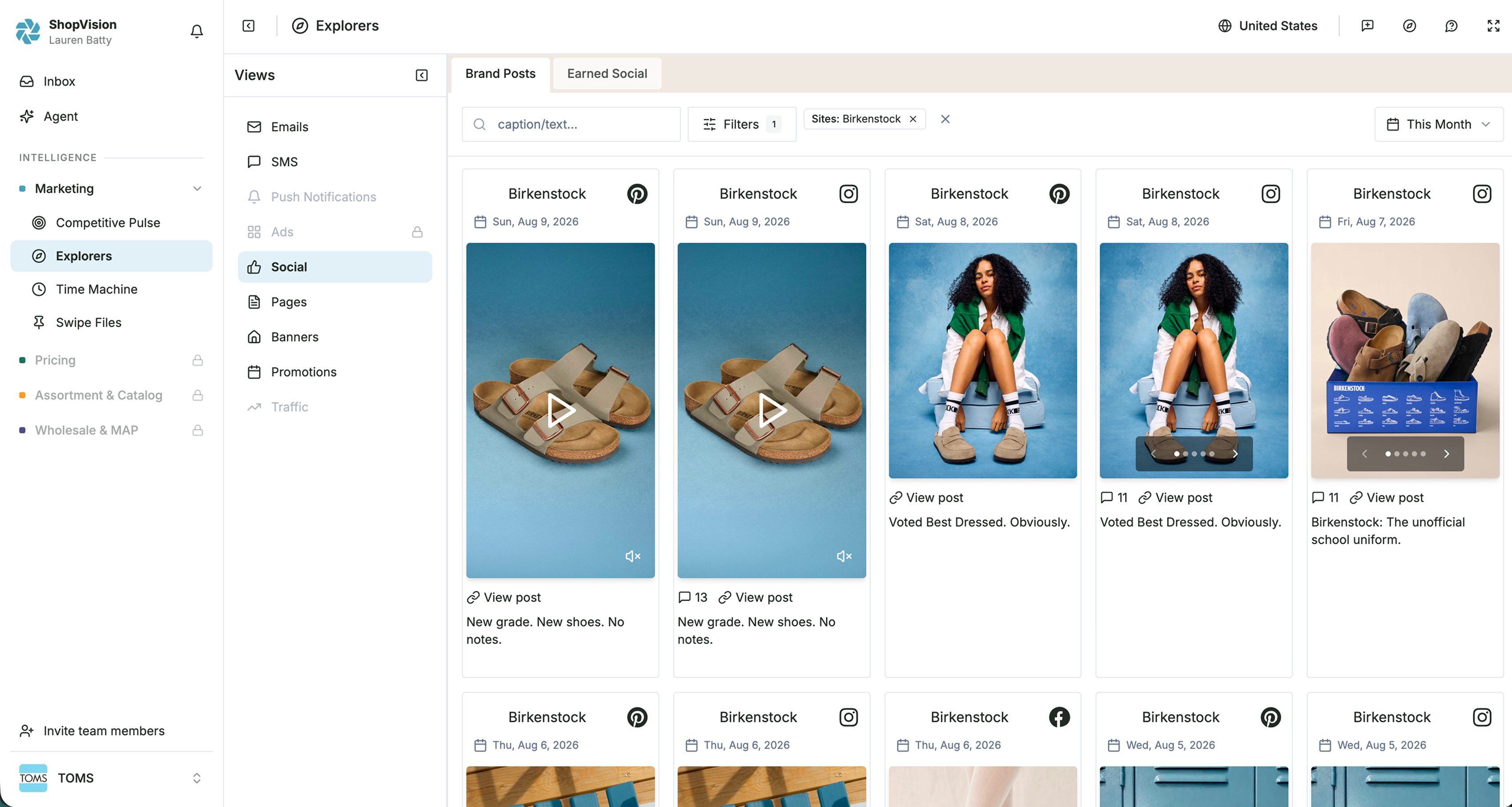
A back-to-school sale, 20% off, and the only genuinely sitewide offer in the set. Our records log it as "Back-to-School Sitewide Sale." Bottles and bags, everything. Opened August 2, reminders on the 3rd and the 6th, "last chance to save" on the 8th. One number, no escalation, its own landing page, in and out.
Outside those six days, nothing else in their August was a discount. A Color Drop waitlist with its own signup flow, a Spider-Man tie-in, a buy-a-tote-get-a-free-bottle offer, and a teachers' giveaway funding $250 Amazon wishlists for ten teachers. Lovely, and also very good marketing.
They email sparingly, about two sends a week. That's up 29% on the prior month, so somebody over there has plans.[^8]
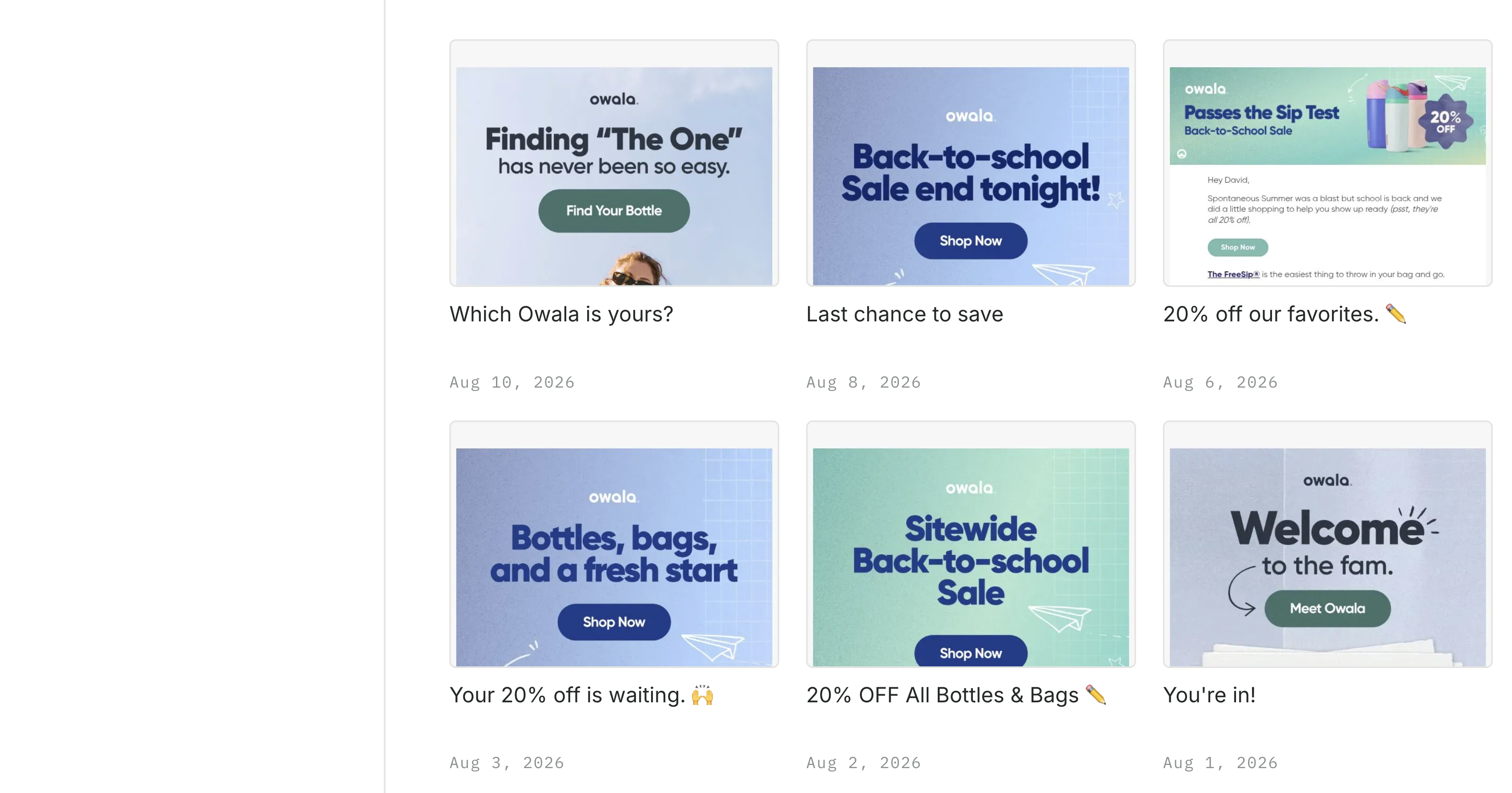
Herschel was first out of the gate by a distance. Their opening back-to-school email went out July 16, ten days ahead of Vans, and it wasn't a sale. "It's Time to Go," straight through to a back-to-school landing page.
There are two offers in the whole season and neither one discounts a backpack. From July 16, buy a backpack and get 20% off a lunch box and pencil case. From late July, a free water bottle with any backpack bought at full price, and full price is the operative phrase. Everything else is new product. A LEGO collection for kids, Peanuts prints, a Minecraft collab, then Thrasher on August 1. Free shipping over $75 sits underneath it all as the standing offer.
The spend is the interesting part. 576 paid assets in thirty days, more of them pointed at that back-to-school page than anywhere else, and email volume up 16% on the prior month. So they're buying a lot of attention and then holding price when you get there.
And their social this week has been "Classroom heroes" and "Ready for roll call," both aimed at the Little Herschel kids' line. So they're talking to parents of small children, not the fifteen-year-old buying their own backpack.[^9]
Ranked by average discount depth on record: Herschel 37%, Vans 36%, Birkenstock 29%, Crocs 27%, Owala 23%. Fourteen points of spread inside one shopper segment, all pointed at roughly the same kid.
What I can tell you for certain is that these five are not running the same season. One is laddering discounts, one is stacking them, one is tiering by loyalty status, one opened and shut a six-day window, and one is spending heavily to sell licensed product at full price. That's not noise. It's five different philosophies about what price is for, running at the same time, at the same shopper.
Whether it predicts November 2026 is the open question, and the ceiling is where I'd put my money. August tells you how far a brand will go, not how it'll get there. The depth a competitor reaches when the stakes are low is usually a policy rather than a campaign decision, set somewhere above the marketing team, and policies don't tend to move between seasons. The mechanics do move, because bundles make sense for a school kit and gift tiers make sense in December.
If that's right, the takeaway is small but usable. The deepest number a competitor hits in August is a fair estimate of how deep they'll go in November. Everything else about their November offer, sitewide or select styles, one weekend or a full month, discount or bundle, gets decided later, and August won't tell you.
Say you saw all five of these playbooks unfold in real time. What would you actually change?
If a competitor walks to 60% off in August on select styles, you know their November floor is at least that, and you can decide now whether you're matching, undercutting or holding. Deciding in August is cheap. Deciding on November 25 is not.
If their seasonal email rides a promo code that was already running, their Black Friday will be a re-skin of a sale that's live now, on a calendar that's already fixed. You can predict roughly when it lands and plan your own timing around it.
And if they run no seasonal offer at all and sell newness instead, price isn't the fight in that matchup.
The more useful moves, though, are the ones that don't involve discounting at all.
Stop bidding into the expensive fight. Herschel pushed 576 paid assets in thirty days, most of them pointed at their back-to-school page. Crocs more than doubled their paid volume on the prior month. If you're bidding the same products and keywords while two competitors are spending like that, you're paying inflated costs to lose on price anyway. Sitting out the most contested terms is a margin decision, not a retreat, and knowing which terms those are is the whole trick.
Go at the corner of the category nobody is in. Birkenstock is selling sandals and clogs into September while everyone else sells shoes for a classroom. Owala sold bottles and bags for six days and went quiet. There is almost always a slice of the category with nobody fighting over it, and a season like this is when you can see which slice is free.
Watch for their stock-outs. This is the one I'd put money on. When a competitor goes to 60% off on select styles, the popular sizes and colours clear first, and they go out of stock on marketplaces and at retail partners well before anyone updates a homepage. If you can fulfil that demand from your own inventory inside a day, their promotion turns into your revenue. That means watching availability rather than price, which is not what most competitive reports look at.
So, five things worth having someone watch between now and October:
That's a weekly habit rather than a project. One owner, a named competitor list, and a note of what changed.
None of this is secret, which is the part people get wrong about competitive intelligence. It's scattered. Five brands, four channels, fifteen storefronts between them, twenty-six days, and offers that appear on a Tuesday and are gone by Friday. Any one piece is findable if you know to look for it on the right day. Nobody has the whole picture in front of them, and that is the actual problem.
That's the whole reason we built ShopVision, so if you'd like your own competitors read the way I've read these five, come and ask us. And if you have been watching yours for a year or more, you can answer my question far better than I can. Tell me what you saw.
When is Black Friday 2026?Friday November 27, 2026. Cyber Monday is November 30. The BFCM window most brands plan against runs from roughly November 20 to December 1.
When should you start competitive monitoring for Black Friday?Before October. By October competitors' promo calendars are signed off and their discount depth has been through finance, so you can see what they're doing but can't respond to it. August and September are when the information is still actionable.
How deep do brands discount before Black Friday?In this set of five teen and tween brands, August seasonal offers ran from 20% to 60% off. Vans reached deepest at up to 60% on select styles. Owala's 20% was the only sitewide offer. Birkenstock ran no seasonal offer at all, just clearance.
Should you start your Black Friday sale early?Three of these five brands opened their back-to-school offers in the last week of July, ahead of the season itself, and the NRF found 62% of back-to-school shoppers had already started by early July. Early starts are now normal rather than aggressive, which is worth knowing before you plan a single-weekend event.
Does pre-season discounting predict Black Friday depth?Untested here, and it's the open question in this piece. The hypothesis worth testing on your own competitive set is that off-peak seasons reveal a brand's discount ceiling, since depth tends to be policy, while the mechanics change between seasons.
How do you track competitor Black Friday promotions?Daily capture across every channel where offers appear, homepage, email, paid media and social, on every storefront a brand runs, then deduplicated so one promotion isn't counted five times. Offers in this window appeared and disappeared inside three days, so weekly or manual checks miss them. Each brand's record is linked below.
Market sizing
Brand behaviour
All promotional dates, campaign codes, offer depths, email and paid media volumes come from ShopVision's own daily capture, current to August 9, 2026. Records publish on a three-day lag.
Discount depth averages are calculated across each brand's full captured promotional history rather than the back-to-school window alone.
ShopVision platform figures as of August 9, 2026.