.png)
.png)
.png)
Platform
Who's it for?
Compare



Twelve months ago, shoppers arriving at US retail sites from AI assistants converted about 40% worse than everyone else. The industry take at the time: AI sends curious browsers, not buyers.
Today those same shoppers convert 42% better.1 Not against one channel, against the entire rest of the traffic mix, paid search and email included. A year ago that same traffic converted 38% worse. An 80-point swing in one year.
I watched mobile take a decade to earn that trust. AI shopping took twelve months.
And the volume is following. Traffic from AI sources to US retail sites is up roughly 1,300% since late 2024.2 About 40% of consumers say they've now used AI for online shopping, and 8 in 10 of those say they're using it more, not less.3

What doesn't go back in the bottle is what these tools have given the consumer: every price, every alternative, every "sale" that isn't one — with none of the work.
That changes what brands and retailers can get away with. Which is really what this post is about.
Here's an uncomfortable truth about the last twenty years of retail: a meaningful amount of margin was protected by how much work it takes to comparison shop.
Price comparison has technically been possible since Google Shopping launched two decades ago. But actually doing it meant opening twelve tabs. Figuring out whether the "Midnight Navy" jacket on one site was the same product as the "Deep Ink" jacket on another. Checking whether the promo code stacked and if shipping came free. Remembering what the price was three weeks ago, before the "sale."
Only the determined few ever jumped through all the hoops. So brands didn't have to be the best option in the market. They just had to be visible — rank high enough, bid high enough, to be among the handful a shopper actually saw.
That era is ending. An AI assistant sees the entire market at once. It weighs features and tradeoffs, distills what matters from the reviews, and knows every price in real time. And it doesn't hand back a list of links — it hands back a decision: here are your three, and here's the one for you.
Manual effort was the moat around mediocre offers. The effort just went to zero.
One more stat that should give every pricing team pause: around 80% of consumers who shop with AI say they feel more confident in their purchases.4 Confident consumers are informed consumers. And informed consumers are brutal on weak offers.
None of this is landing on steady ground: retail unit economics have been sliding for years.
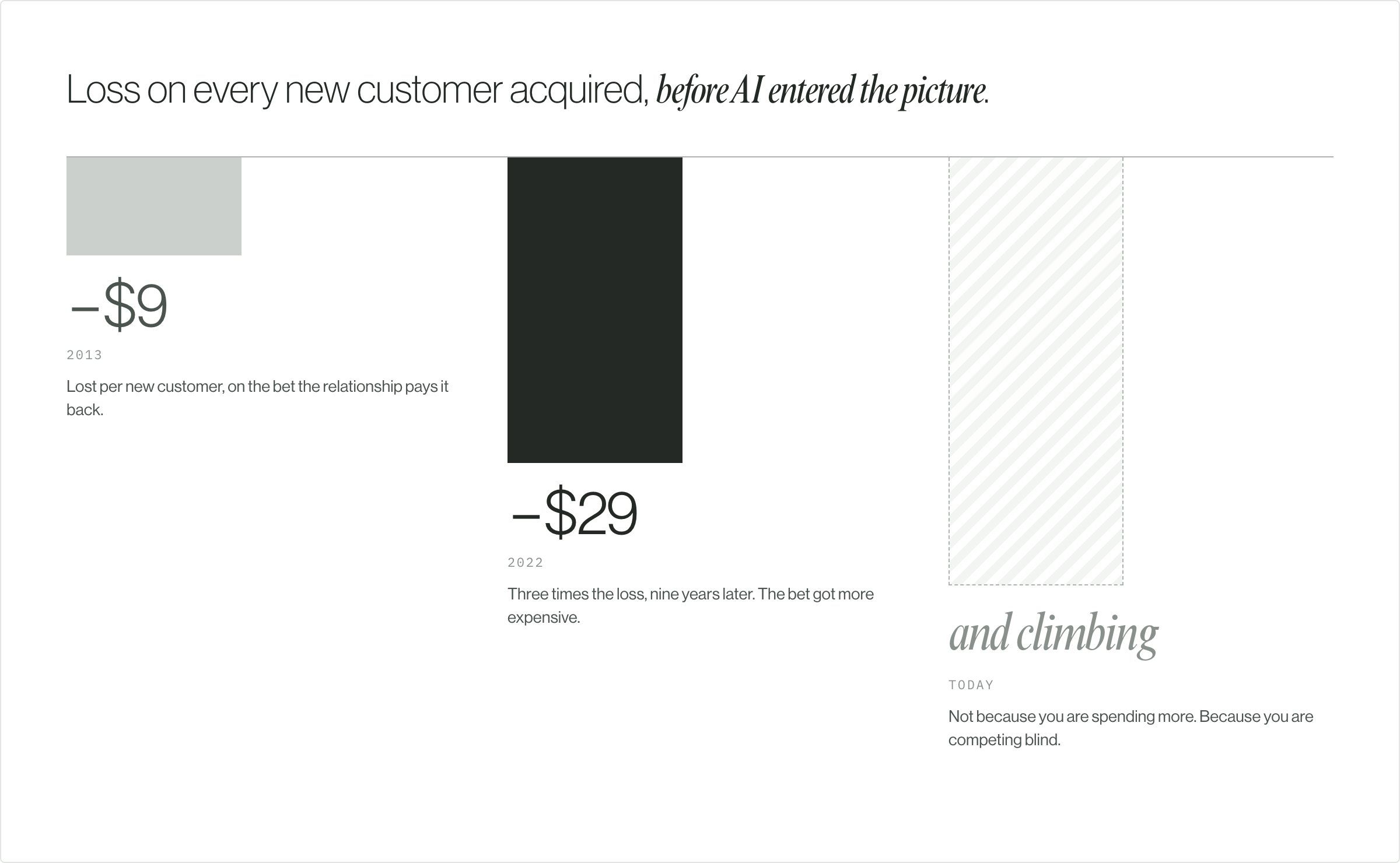
In 2013, merchants lost about $9 on every new customer they acquired, betting the relationship would pay it back. By 2022 that loss had grown to around $29 per customer.5 And costs haven't slowed — CAC is up roughly 40% again just since 2023.6 Every quarter CAC creeps up, and mostly not because you're spending more. It's because you're competing blind.
Think about what actually happens to a brand in a normal month. A competitor starts their BFCM ramp two weeks early and takes the demand you banked on. A downstream retailer breaks price, a marketplace matches it, and the margin's gone before anyone even flags it. And somewhere out there a reseller is breaking MAP — you'll find out from a customer complaint.
You experience all of these the same way: in your own numbers, weeks later, as a mystery. Then someone spends three days building a deck to explain what "probably" happened.
Now add consumers with perfect information to that picture. Every gap between your offer and the market's best offer used to be invisible to most shoppers. Now it gets surfaced automatically, in the moment, by a tool the shopper trusts. Brands with a weak read on their own market are about to have that weakness exposed at scale... by their customers' software.
When the opacity lifts on price and availability, what's left is what was always harder to copy: service, experience, brand, how it feels to buy from you and to own the thing afterward. Honestly, that's good news. That's the fun part of building a brand.
But here's the catch, and I really think this is the part people miss: you only get to focus on experience if understanding your market stops consuming your organization.
The same transparency that drained the old moat fills the new one.
The companies that get this have made market and competitive intelligence part of the actual operating system of the business. Not a spreadsheet one overworked analyst updates. Not a weekly file nobody opens. A live layer in the stack that their teams, and increasingly their AI agents, work from.
In the same way consumers use agents to make faster shopping decisions, brands and retailers can now compete with a level of speed and precision that wasn't previously possible. When every product launch, pricing move, category expansion, promotional campaign, email flow, ad creative, and policy change is captured and classified by AI, agents can translate data into actionable workflows and executable decisions.
I've watched this up close, and the difference is stark.
A lean marketing team in a brutally crowded category used to find out about competitor promos after they'd run. Now they see campaigns, launches, and stockouts as they happen — so when a rival's bestseller goes out of stock, they move spend toward that demand the same week. They know what ad creatives perform best for their peers — the creative brief is data-driven. Same headcount. Completely different playbook.
I heard a director of pricing at a multi-billion-dollar manufacturer describe the monitoring tool he was paying for as "a data dump we have to take, manipulate, and make usable." His team was spending its week being a human data pipeline. The teams pulling ahead have flipped that ratio: the machine does the collecting and the matching, and the humans make the calls.
A heritage brand whose MAP enforcement was pure whack-a-mole started catching violations on products resellers had renamed specifically to dodge detection. They even found their own products silently delisted from Amazon, losing sales nobody knew were being lost. You can't fix what you can't see. Now they can see.
The loop is the new moat.
Notice the pattern in each: rich market data, combined with the company's own first-party data, feeding workflows and automations. That combination is the compounding asset. The market tells you what's happening, your own data tells you what it means for you, and the automation drives the response in hours instead of quarters. Once that loop is running, every campaign, every buy, every price move starts from a better position than your category average. It stacks.

And it matters more, not less, as commerce goes agentic. If you're building AI agents to plan pricing or brief campaigns (and you will be), those agents are only as good as the market intelligence they can reach. An agent with no market context is just a very fast way to make uninformed decisions.
Now the part I'd want someone to say to me straight if I were on the other side of this.
If you can't see your market, it will move without you.
Your competitors will build this muscle. They'll start campaigns before you, because they move with the market while you're locked to a marketing calendar. They'll close the white space you were "planning to look at next season" while you're not looking. They'll price right while your stock slides from full price to third-wave markdown. Their site, their assortment, and their offers keep iterating against a live read of the market. Yours iterate against last quarter's deck.
You won't lose in one dramatic moment. You'll lose in a thousand small ones, and you'll misdiagnose most of them.
Your best people will spend their time compiling, not deciding — building the deck that explains what happened instead of capturing the next opportunity. That's the most expensive line item you have: the strategic capacity you burn doing manually, badly, and late what your competitor's stack does continuously.
The old tooling won't save you either. The scrape-and-dump model, a weekly file and a dashboard nobody opens, never did the analysis. The market has rendered its verdict on that model: the largest vendor in that world filed for bankruptcy this spring.7 Meanwhile, the things that made real market intelligence impossible, matching products with no shared codes, reading a reseller site the way a person does, understanding a whole category at once, just became possible with AI. The excuse and the alternative disappeared in the same year.
Consumers already made this leap. Their tools got to the bottom of everything, and they got confident. The only open question is whether the companies selling to them will see the market as clearly as their customers now do.
Obviously I have a horse in this race...it's the reason we started ShopVision. But I'd hold this view even if I didn't, because I lived the last version of it. Twenty years ago the argument was whether you needed a real ecommerce platform or whether a brochure site was fine. The companies that treated digital as core strategy compounded for a decade. The ones that treated it as a checkbox spent that decade catching up. Some never did.
Market and competitive intelligence is at that same moment. In a few years it won't be a category you evaluate. It'll be a layer you assume, sitting under pricing, marketing, merchandising, and channel the way analytics sits under everything today.
The consumers are already there. The technology is already there. The gap is whether leadership decides this is core strategy or a nice-to-have.
Net net: transparency is coming for every offer in your category, including yours. The brands that can see their whole market get to spend the next decade on the good stuff, the experiences and the service that actually win informed customers. Everyone else gets to spend it explaining variances.
I know which side of that I'd want to be on.