%20(23).png)
Platform
Who's it for?
Resources
Compare

.jpg)
Pricing teams do not lose margin because they are careless. They lose it because the data in front of them quietly misleads, and a confident decision made on a partial picture looks exactly like a confident decision made on a complete one. You only learn which kind it was later, in the numbers.
Here are five blind spots that show up again and again, across categories and price points. None of them are exotic. That is what makes them expensive.
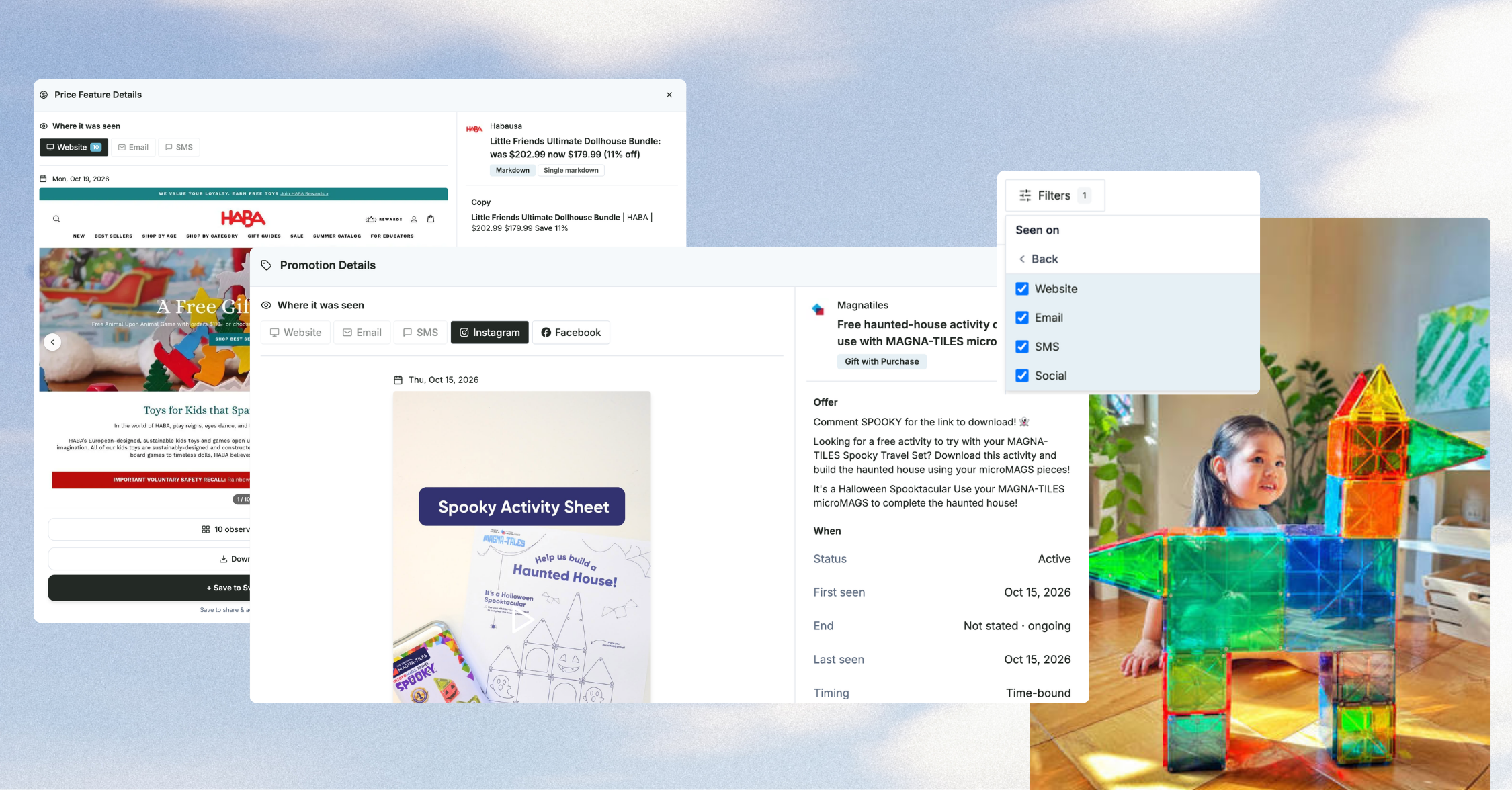
The number on the shelf is not the number that wins the sale. A competitor can hold their list price perfectly steady and still cut their effective price overnight, with a 20 percent email to their database, a banner promotion, or an offer that never touches the product page. If you are watching list price alone, you see none of it.
The effective price is list price plus active promotion plus whatever offer is sitting in the customer's inbox. That is the number you are actually competing against. Most teams track the first part and miss the other two, then wonder why a competitor who looks more expensive keeps winning. Boston Consulting Group has reported that retailers spend more than a trillion dollars a year on promotions while rarely understanding their impact. The promotion is moving the price. The tracking just is not watching the right number.
Here is a gap that looks like a problem and is not. A competitor appears 12 percent cheaper, the team scrambles to respond, and half of that gap turns out to be shipping the competitor folded into the advertised price while you price it separately.
It is a quiet way to lose margin, because the correction feels responsible. You saw a gap, you closed it. But you cut price to match a competitor who was never actually cheaper, and the margin is gone for no competitive reason at all. Comparing prices without comparing what is inside them is not a comparison. It is a guess with numbers attached.
Matching is where competitive pricing quietly goes wrong, because the failure is invisible. A tool pairs your product with a competitor's because the names look alike, and every price comparison, every gap, and every decision built on top inherits the error without anyone noticing.
Two products with nearly identical names can be entirely different in the ways that set price: different specifications, different inclusions, different things the customer is actually buying. If the match underneath is wrong, the analysis on top is confidently wrong, which is the worst kind. The real question is not whether your tool matches products. It is whether you can see the match, correct it, and trust it enough to make a margin call on it.
Speed is its own blind spot. Harvard research found that retailers now change prices roughly twice as often as they did a decade ago, and that a price once held steady for about nine months now moves in about three. The market reprices in days. A lot of teams still review on a schedule.
When you learn about a competitor's move two weeks after it happens, the damage is already done. You have either lost the sales you were going to lose, or trained the customers you share to expect the lower price. The difference between catching a move on day one and catching it on day fourteen is often the difference between protecting margin and handing it away. A monthly report cannot keep pace with a market that does not wait for your calendar.
This is the one that surfaces in front of executives. Someone asks a simple question, who are our top three competitors on our best product in our biggest market, and the honest answer is a pause. Teams fall back on instinct, old assumptions, and whoever came up most often last year.
The trouble is that the answer changes by product, by market, and by season, and instinct does not keep up. The competitor pressuring you hardest on one product in one region is often not the one you would have named. Until you can answer that question from current data rather than memory, you are setting price against a competitive set that may no longer exist. We think is not a strategy. We know is.
None of these are analysis failures. They are visibility failures. The teams getting caught are not worse at pricing. They are working from a picture that is missing the promotion, the shipping, the real match, the timing, or the true competitive set.
That is the shift underneath all five. The job used to be monitoring prices. Now it is making decisions, and you cannot make a good decision on a partial picture. The teams pulling ahead are not the ones watching the most prices. They are the ones who can see the whole picture in time to act on it.
This was written by ShopVision. We build pricing intelligence for exactly this problem: real-time signal, matching you can audit, and the full competitive picture, list price, promotions, shipping, and the real competitive set, all in one place.
If you want to find out which of these blind spots you are exposed to, our two-minute pricing maturity assessment will show you where you stand. And when you want to see what closing them looks like in practice, we will walk you through it in 20 minutes, with no commitment.