Back

How Retail Leaders Use Price Intelligence to Drive Smarter Decisions

April 16, 2026
|
Amrit Shergill

Retail leaders are upgrading from reactive price checks to an always-on, contextual understanding of the market. Price intelligence — collecting, analyzing, and acting on competitive pricing and promotional data — helps teams move faster, protect margins, and avoid costly missteps. In practice, that means enforcing MAP without friction, tracking prices and assortments across retailers, automating high-confidence alerts, and interpreting price moves through the lens of campaigns and inventory. The smartest teams now pair eCommerce AI pricing monitoring tools with a unified layer that explains not just where prices changed, but why — and what to do next. This article lays out how to operationalize that capability, the role AI and predictive analytics play, and how to balance speed with governance and trust.

The Strategic Importance of Price Intelligence for Retail Leaders

Price intelligence is the discipline of collecting, analyzing, and acting on market and competitor pricing data to make informed, agile pricing decisions. When done well, it upgrades pricing from manual guesswork to predictive, outcome-based strategy.

  • Business impact: Retailers using price intelligence report better pricing responsiveness, improved demand sensing, fewer stockouts, and clearer elasticity insights. These are measurable levers for margin and market share uplift.
  • From tracking to interpreting: Price intelligence tools and dynamic pricing models surface competitive pricing data in near real time. But the bigger risk today isn't a slow reaction — it's overreacting to incomplete signals.
  • Pricing noise vs. signal: Short-term, campaign-driven discounts, retailer-specific bundles, or clearance events can look like market price resets. Without context (assortment changes, promotions, or channel-specific campaigns), teams can spiral into price wars that permanently erode margins.

The strategic shift is clear: pair competitive visibility with interpretation so pricing moves align with demand, brand strategy, and profitability targets.

Understanding MAP Pricing and Its Enforcement in Retail

MAP, or Minimum Advertised Price, is the lowest price that a retailer is allowed to advertise for a product, as set by the brand or manufacturer, in order to protect brand value and channel relationships. MAP policies are designed to sustain healthy margins and prevent race-to-the-bottom dynamics across partners.

Modern MAP enforcement blends automation with collaboration:

  • Automated retailer compliance monitoring: Continuously track online ads, product pages, and digital flyers for advertised price breaches.
  • Real-time pricing alerts for violations: Trigger notifications the moment a product drops below MAP, with evidence and timestamps attached.
  • Collaboration and escalation: Share findings with account teams, distinguish sanctioned promotions from true violations, and escalate only when necessary.

Manual spreadsheets and spot checks create bottlenecks and inconsistent enforcement, driven by recurring pain points like data silos, manual matching, and slow reconciliation — challenges that technology now addresses with normalized feeds, rules, and audit trails.

Tracking Pricing Across Retailers: Methods and Best Practices

Relying on ad hoc spot checks and spreadsheets introduces latency and risk. Teams may know where a price moved, but not the "why" — a promotion, a delist, or a competitor's inventory issue. High-performing programs combine coverage, cadence, and context to track pricing across retailers and assortments at scale.

Comparison of tracking methods:

MethodCoverageStrengthsWatch-Outs
Automated price monitoring toolsBroad, multi-retailer price and availabilityReal-time monitoring, assortment tracking at scale, built-in alertsRequires product matching discipline and noise filtering
Real-time web and digital shelf scrapesHigh-frequency captures of PDPs, PLPs, ads, and bannersGranular evidence, detects promo badges, bundles, and shipping thresholdsNeeds normalization and interpretation to avoid overreaction
Scheduled competitive shop auditsSnapshot comparisons (weekly / biweekly) across key SKUs and geosUseful for governance reviews and cross-functional calibrationMisses rapid changes between audits

Popular eCommerce AI pricing monitoring tools like ShopVision, Prisync, and Priceva automate much of the legwork — real-time monitoring, assortment change detection, and alerting — so analysts spend more time on decisions and less on data wrangling. Still, the win comes from connecting visibility with intent.

Automating Alerts for Pricing and Assortment Changes

Automated alerts are notifications triggered by software when competitors or partners change prices, run promotions, or alter assortments. Automation reduces repetitive labor, curbs margin leakage, and ensures consistent policy enforcement across categories and geographies — exactly where manual teams struggle most.

Recommended alert types and triggers:

  • Price drops below MAP with retailer, SKU, and evidence capture
  • Competitor price undercut thresholds (e.g., >3% below your floor)
  • New product launches, delistings, or back-in-stock events
  • Promotional campaign changes (start, stop, depth change, or stackable coupon detected)
  • Digital shelf shifts (badges, shipping thresholds, free gift-with-purchase)

To accelerate collaboration, route multi-channel alerts to Slack, Microsoft Teams, and email with role-based filters. Treat alerts as decision filters, not reaction triggers: the most effective pricing teams act on fewer, higher-confidence alerts that incorporate campaign, inventory, and seasonality context.

Platforms that Provide Unified Insights on Pricing, Assortment, and Campaigns

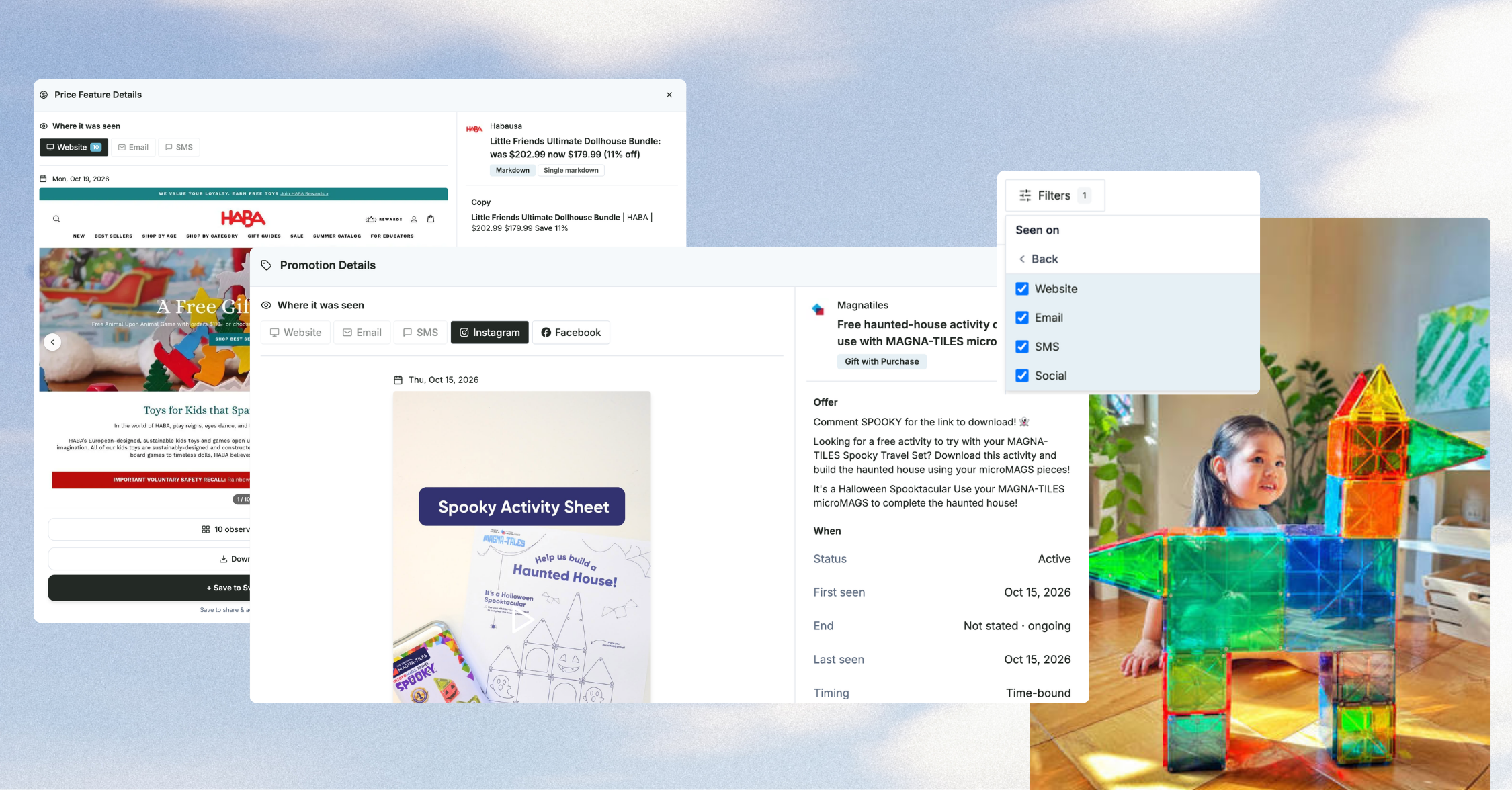
Unified insights connect price moves to campaign intent and assortment dynamics so cross-functional teams interpret competitive behavior, not just react to isolated data points. The result is faster decisions, clearer attribution of margin impacts to promotions, and fewer data silos.

Manual vs. unified approaches (illustrative):

CapabilityManually Stitched ToolsUnified Platform (e.g., ShopVision)
VisibilityFragmented (spreadsheets, screenshots)Consolidated price, promo, and assortment views
SpeedSlow collection and reconciliationNear-real-time updates with normalization
AccuracyProne to matching errors and stale dataProduct matching, deduplication, and audit trails
InterpretationLimited campaign contextPrice moves linked to promo intent and duration
CollaborationAd hoc sharingRole-based workflows and alert routing
OutcomesReactive discounts, margin erosionDisciplined moves aligned to strategy and demand

To see how unified pricing intelligence streamlines cross-functional execution, explore ShopVision. Omnichannel consistency matters: customers expect alignment across online and in-store channels, so connecting insights to execution is non-negotiable.

Combining Price Monitoring with Campaign Intelligence for Competitive Advantage

Campaign intelligence is the continuous tracking and analysis of competitor or partner marketing activity — discounts, offers, ads — alongside price movements. Used as context for pricing decisions, campaign signals explain intent, timing, and expected duration of price moves.

How this translates into advantage:

  • Proactive response to competitive moves: Detect the launch of a 3-day promo and calibrate short-term pricing or ad spend accordingly.
  • Improved promotion planning and analytics: Attribute margin swings to specific competitor offers, not just price gaps, and refine future promo playbooks.
  • Stronger understanding of market share dynamics: During key periods (e.g., Back-to-School), link your share fluctuations to competitive promo depth and cadence.

ShopVision's Time Machine visual archive helps teams review historical price and campaign sequences to predict likely competitor tactics and improve go-to-market timing — separating durable strategy shifts from promotional noise.

Operational Challenges and Solutions in Price Intelligence Implementation

Common hurdles:

  • Siloed data sources and inconsistent product matching across channels
  • Manual processes that slow analysts and invite errors
  • Master data misalignment (SKUs, variants, geos)
  • Platform reliability and data freshness concerns

How to work through them:

  • Centralize and govern master data before scaling automation
  • Invest in high-quality, normalized data feeds with auditability
  • Establish human-in-the-loop oversight for complex pricing models and exceptions

Industry adoption of competitive pricing data is on track to reach ~80% by 2030, underscoring the urgency to modernize ops and governance.

The Role of AI and Predictive Analytics in Dynamic Pricing

Dynamic pricing is a strategy where product prices adjust automatically in real-time based on demand, competitor prices, and other market factors. ShopVision supports dynamic pricing strategies as an intelligence input layer — surfacing decision-grade signals — while leaving price execution to your pricing engine or POS systems.

  • Industry practice: Marketplaces like Amazon and other large retailers adjust prices multiple times per day using machine learning and rules-based logic.
  • Quantified impact: IDC reports that price optimization initiatives can yield 1–3% margin uplift in year one, with double-digit gains as models learn and scale.
  • Strategic imperative: BCG notes that sophisticated pricing is increasingly infeasible without AI, as data volume and competitive velocity outstrip manual capabilities.

Managing Compliance, Transparency, and Customer Trust in Pricing Automation

As algorithmic pricing expands, so do regulatory and reputational risks. Policymakers are pressing for greater transparency, and consumers expect fairness — especially around personalized offers and service fees. Recent commentary highlights heightened scrutiny of retail platforms and delivery intermediaries, including transparency demands around how prices and fees are presented.

Best practices:

  • Transparent algorithm and pricing explanations in customer-facing FAQs and support scripts
  • Human approval layers for critical pricing changes (e.g., below-floor exceptions)
  • Regular audits of model outcomes for bias, accuracy, and policy compliance

Balance assertive competitive tactics with long-term brand trust. Governance is a growth enabler, not a brake.

Future Trends Shaping Retail Price Intelligence and Decision-Making

  • Near-universal adoption: Competitive price intelligence will be table stakes, with a shift from passive monitoring to predictive, real-time optimization.
  • Omnichannel execution: Digital shelf insights and electronic shelf labels (ESLs) will tighten the loop between insight and in-store action.
  • Tighter regulation: Expect stronger disclosure norms and audit requirements around automated pricing.
  • Advanced personalization: Segmented and context-aware offers will scale — with stricter controls to preserve fairness.

The leaders who win will treat price intelligence as a strategic asset — integrating AI, automating with governance, and proactively managing trust. That's ShopVision's starting point: turn competitive price changes into decision-grade signals by separating strategic moves from promotional noise.

Frequently Asked Questions

What is price intelligence and why does it matter for retail leaders?

Price intelligence uses real-time competitive data and analytics to guide pricing, helping leaders respond faster, protect margins, and allocate promotions more effectively.

How can AI improve pricing strategies and execution?

AI analyzes pricing and demand signals at scale, simulates outcomes, and recommends actions in real time — improving responsiveness, inventory balance, and profitability.

What are the benefits of automating price and assortment monitoring?

Automation reduces manual effort, speeds detection of market shifts, and helps teams act quickly on high-confidence opportunities while minimizing margin leaks.

How do retailers balance personalized pricing with fairness and transparency?

Use opt-ins and clear explanations for offers, apply human review to sensitive changes, and audit models regularly to maintain customer trust.

What operational practices ensure successful price intelligence initiatives?

Align master data, invest in normalized feeds and analytics, establish governance with human-in-the-loop review, and train teams to act on decision-grade alerts.

Sources & Further Reading

  • BCG — five trends defining the future of pricing strategy
  • IDC MarketScape — worldwide retail price optimization benchmarks
  • Retalon — retail pricing intelligence outcomes and strategy
  • Wiser — modern pricing analyst challenges and automation
  • Displaydata — pricing intelligence and electronic shelf labels
  • Omnia Retail — MAP pricing fundamentals and enforcement
  • Actowiz Solutions — competitive pricing and retail intelligence market outlook
  • Neontri — AI retail trends and dynamic pricing practices
  • Prisync — competitive price monitoring platform
  • Priceva — competitive pricing software

Stop reacting to incomplete pricing signals. Request a demo to see how ShopVision turns always-on price, promotion, and assortment data into the decisions your team can act on today.