.png)
%20(23).png)
Platform
Who's it for?
Resources
Compare


Competitor analysis used to be a quarterly exercise. A team would gather data, produce a deck, and the findings were stale by the time the deck shipped. That model is breaking. AI-driven competitor analysis turns market intelligence into a continuous capability — one that reads price changes, promotions, launches, and sentiment shifts as they happen, not after the fact.
Adoption is no longer a niche trend. 72% of businesses now use AI for competitive intelligence, and that's projected to hit 90% by 2025. Companies using AI for market intelligence report revenue growth of 10–15%, well above peers relying on manual methods. Teams tracking competitors also report a 76% year-over-year increase in AI adoption for this specific workflow.
For ecommerce and retail brands, the shift is even more acute. Pricing moves hourly. Promotions launch on weekends. New competitors appear monthly. The teams that win are the ones who see these changes first — and platforms like ShopVision are built for exactly that.
The old model of competitor analysis was labor-intensive and slow. Analysts combed through competitor websites, copied pricing into spreadsheets, tracked ad campaigns by hand, and summarized findings in a report that took weeks to produce. By the time the report landed in an exec's inbox, half the data was out of date.
AI flips this completely. Automated data pipelines pull pricing, promotions, product launches, reviews, and ad activity continuously — then apply machine learning to flag what actually matters. The result is a live view of the market instead of a retrospective one.
Here's how the two approaches compare on the dimensions that matter for ecommerce teams:
DimensionManual competitor analysisAI-driven competitor analysisSpeedWeekly or monthly reporting cycles. Findings are already stale when delivered.Real-time, continuous updates. Changes surface within hours of happening.CoverageLimited to a handful of known competitors. New entrants go unnoticed.Broad coverage across markets, channels, and categories. Catches emerging threats early.AccuracyHuman error, data entry lag, inconsistent tracking methodologies.Machine precision with automated validation. Data is consistent and auditable.CostHigh analyst hours. Most of the cost is in data collection, not analysis.Lower overhead, higher output. Analysts spend time on strategy, not spreadsheets.
This isn't a productivity upgrade. It's a different way of operating. Competitor tracking has shifted from a project to a capability — one that runs in the background and surfaces what your team needs to act on.
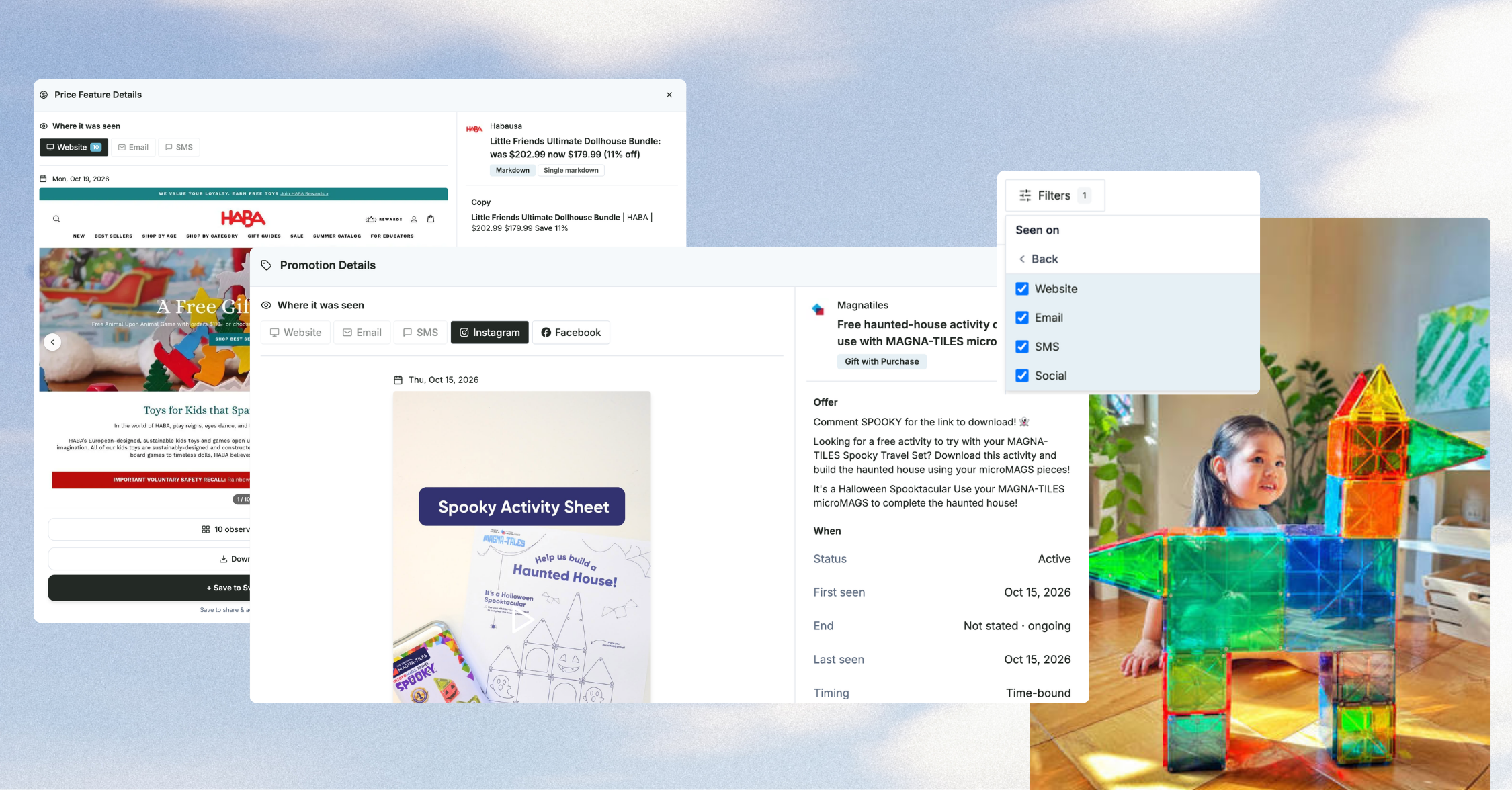
Real-time monitoring means 24/7 automated tracking of every competitor touchpoint that matters: pricing, stock levels, ad creative, new product listings, promo timing, sale start and end dates, shipping policies. Instead of a weekly pull, AI detects the change and pushes an alert the moment it happens.
This is where ShopVision's Super Agent comes in. When a competitor drops price on a SKU you care about, launches a flash sale, goes out of stock on a hero product, or lists something new, the alert hits your inbox or Slack channel immediately. Your team can respond the same day instead of finding out a week later in a pivot table.
The business impact is less about the alert itself and more about the compression of decision cycles. When you're tracking 40 competitors manually, you're always reacting to yesterday's move. When you're tracking them with AI, you're making your own move while theirs is still live.
A massive amount of competitive signal lives in unstructured text — customer reviews, Reddit threads, social media comments, product Q&A pages, forum posts. Natural Language Processing (NLP) makes that text machine-readable at scale.
Pair NLP with sentiment analysis and you get something even more useful: early signals of customer frustration or enthusiasm, before they show up in revenue numbers. Large language models can detect subtle patterns — a recurring complaint about a competitor's sizing, a surge of enthusiasm about a new feature, a shift in tone around a specific brand — that a manual review team would never catch.
A real-world example: a snack brand ran NLP on competitor reviews and spotted repeated negative mentions of texture in a rival's product. They launched a premium line six weeks later that addressed exactly that complaint. Six weeks is a feasible product timeline when you know what to build. It's not feasible when you're starting from a blank page.
ShopVision pulls these patterns out automatically and connects them to the products, SKUs, and categories they affect — so the insight shows up next to the data you use to act on it.
Predictive analytics uses AI models and statistical algorithms to forecast what's likely to happen next based on historical patterns. For competitor intelligence, that means anticipating a rival's next move: when they're likely to discount, which categories they'll expand into, when a new campaign is coming.
ShopVision's Time Machine fuses multiple signals — pricing history, sentiment shifts, review volume, ad spend patterns — into trend forecasts and "what-if" simulations. You can test a pricing move before making it. You can model what happens if your top competitor launches the product you suspect they're working on. You can see which categories are trending up across the market before investing in inventory.
This is the difference between reactive and anticipatory strategy. Reactive means you adjust when a competitor moves. Anticipatory means you're already positioned for the move they're about to make.
Market intelligence used to be a specialist function. Data scientists and senior analysts owned it, and everyone else waited for a monthly email summary. Conversational AI breaks that bottleneck. Now a category manager can ask "what did our top five competitors change on price this week?" and get an answer in plain English, without opening a dashboard.
Organizations using conversational intelligence tools for competitor insight report up to 82% higher sales effectiveness. The mechanism is simple: when every team can self-serve the data they need, they act on it faster and more often.
Different roles use the same underlying intelligence differently:
RoleWhat they use AI-driven competitor intelligence forCategory managersTrack assortment, pricing, and stock changes across their competitive set.Marketing leadsMonitor campaign timing, creative, and channel mix to spot whitespace.Agency strategistsBenchmark creative performance and promo effectiveness for clients.ExecutivesGet concise, role-relevant summaries without having to learn a dashboard.
ShopVision delivers these role-specific digests straight to Slack, Teams, or email. No dashboard to train on, no query language to learn. The insight shows up where the work already happens.
AI doesn't replace human expertise. It handles the parts humans aren't good at — continuous monitoring, pattern recognition across millions of data points, anomaly detection — and leaves the parts humans are good at: interpreting context, weighing risk, making the judgment call.
The best-run teams run AI and human review on different cadences. AI runs continuously and flags what's worth attention. Humans review flagged items on a regular rhythm — daily standups for pricing, weekly for promotions, monthly for strategic shifts — and decide what action to take.
Typical human-in-the-loop work includes validating surprising AI findings before acting on them, leading cross-functional reviews that tie competitor signals to internal strategy, and signing off on major responses (price changes, campaign pivots, product decisions). AI does the lifting. Humans do the deciding.
Using AI for competitive intelligence responsibly means respecting privacy, maintaining transparency, and staying on the right side of frameworks like GDPR and CPRA. For ecommerce teams, a few practices are worth codifying:
ShopVision operates at enterprise data governance standards so retail and ecommerce teams can scale AI automation without compromising on security or compliance.
The numbers around AI-driven competitor analysis are striking. Businesses adopting it report 10–15% revenue growth compared to 5–7% for peers who haven't. They're also 2.5 times more likely to outperform competitors on core business metrics. Cloud-based intelligence platforms now command nearly 70% of the market, reflecting how fast enterprises are scaling this capability.
The gains come from a handful of specific mechanisms:
AI-powered intelligence isn't an upgrade anymore. For ecommerce brands competing on margin and speed, it's the operating model.
AI compresses weeks of manual research into minutes. Automated pipelines collect pricing, promotions, and product data continuously, then surface changes as real-time alerts. Teams get signal the same day a competitor moves, instead of finding out in next month's report.
Real-time monitoring, sentiment analysis across reviews and social media, predictive modeling for forecasting competitor moves, and plain-English automated reporting are the four capabilities that matter most. ShopVision combines all four into one workflow designed for ecommerce and retail.
Let AI handle data collection, pattern detection, and anomaly flagging. Let humans handle context, risk assessment, and strategy calls. The best teams run AI continuously in the background and review flagged items on a regular rhythm — daily for pricing, weekly for promotions, monthly for strategic shifts.
Coverage at scale, speed of detection, and consistency. A human team can track five competitors well. An AI-driven system tracks fifty without losing fidelity, surfaces changes in hours instead of weeks, and applies the same logic to every data point — no bad spreadsheet formulas, no missed updates.
It shortens the gap between market change and business response. When your merchandising, marketing, and exec teams all see the same live data, you stop debating whose numbers are right and start making decisions. The result is measurable: 10–15% revenue growth for adopters, and 2.5x the likelihood of outperforming peers.
AI isn't the future of competitor analysis. It's the current baseline. Teams still running manual workflows are paying the cost in both speed and accuracy — and competing against teams who aren't.
ShopVision tracks hundreds of thousands of ecommerce brands across pricing, promotions, reviews, and ad activity in real time. Alerts hit your team where they already work. Predictive signals help you anticipate moves before they happen. And role-specific digests make the insight usable for everyone — not just analysts. Request a demo to see what your competitive picture looks like when the data is live.